
Here's something we don't want any of our neighbors to miss.
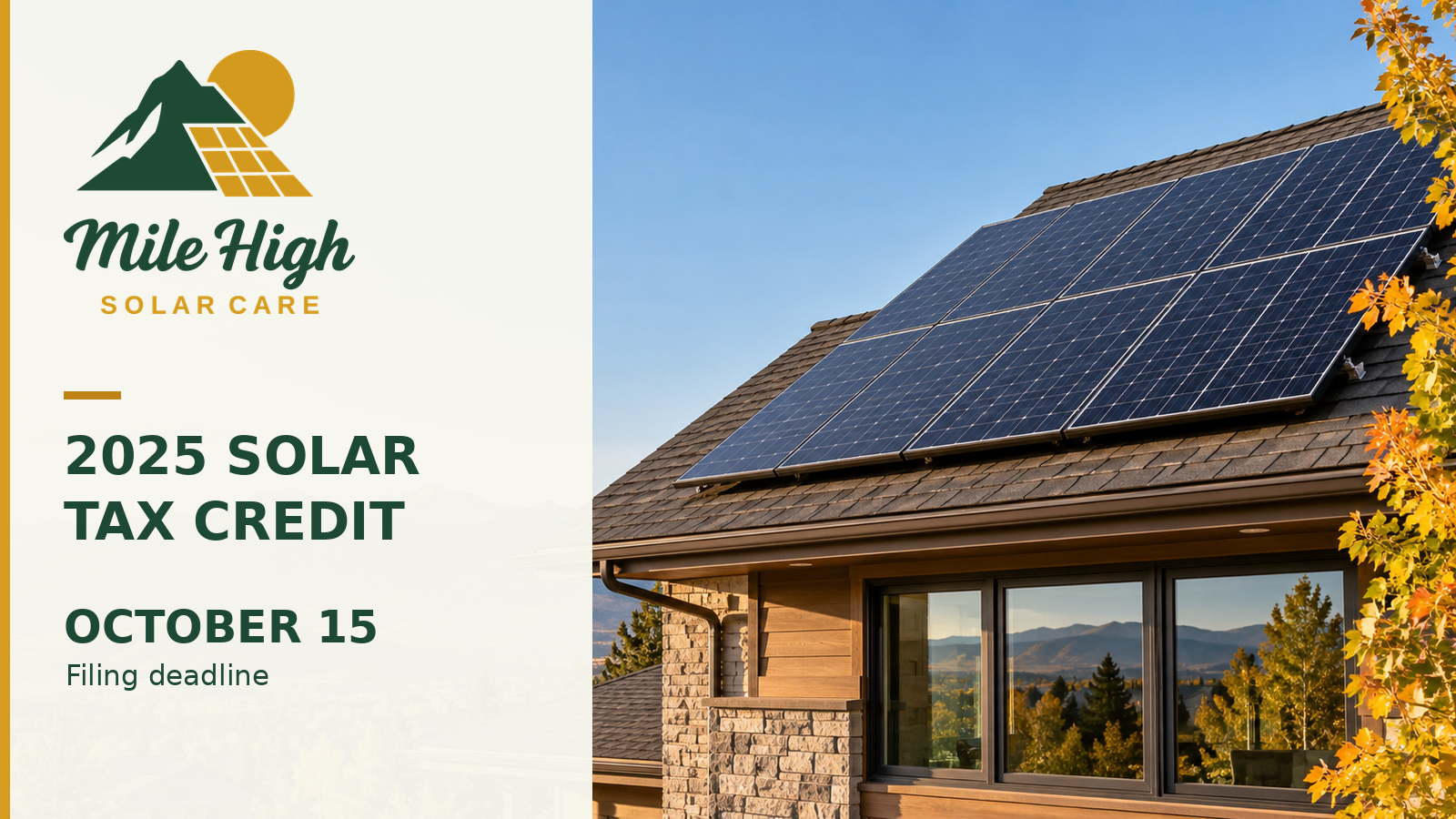
The 30% federal residential solar tax credit ended with 2025. If your system was installed last year and you extended your 2025 federal tax return this spring, October 15, 2026 is generally your deadline to file — and to claim the credit while you're at it.
What Happened to the Credit
For years, homeowners could claim 30% of the cost of a qualifying solar installation as a federal tax credit. Last summer's federal tax law (the One Big Beautiful Bill Act, signed July 4, 2025) ended the residential credit outright — no phase-down. For systems installed after December 31, 2025, the homeowner credit is gone. (IRS: Residential Clean Energy Credit)
If your system was installed in 2025, the credit may still be available to you, subject to IRS eligibility rules. You claim it on your 2025 federal return.
The October 15 Filing Deadline
If you obtained a valid extension back in the spring, October 15 is generally your extended deadline to file your 2025 federal return. (IRS: request an extension) That's the cleanest path to getting the credit claimed: get your records to your tax preparer now instead of scrambling in mid-October.
One thing to know: the extension gave you more time to file, not more time to pay. If you owed tax for 2025, payment was still due back in April. Your tax preparer can tell you what that means for your situation.
Already Filed Without the Credit? You May Still Have Options
If you already filed your 2025 return without the credit, ask your tax preparer whether you qualify to file an amended 2025 return. Refund claims have time limits. (IRS: file an amended return) It's a separate process from filing on time — and it's exactly the kind of question to take to your CPA or tax preparer rather than guessing at.
We mention it because "I already filed" shouldn't stop you from asking.
What to Gather Before You File
A quick checklist — and we mean this as neighbors, not tax pros:
- Your purchase agreement and itemized invoices — including eligible equipment and installation costs
- Receipts and payment records — the IRS recommends keeping your purchase receipts and installation records
- The date your system was installed and completed — for a typical installation, the completion date matters more than when you signed or paid. (The IRS's §25D cutoff FAQ confirms that an installation completed after December 31, 2025 is treated as an expenditure after that date.) Ask your tax preparer about unusual circumstances.
- Ask your preparer about Form 5695 — the IRS form that carries the residential clean energy credit on your 2025 return (Form 5695 instructions)
A note on leased systems: if you lease your panels or have a power purchase agreement, you generally don't own the equipment, and the homeowner credit treats your situation differently. Ask your tax adviser about your specific arrangement before assuming anything.
One more thing worth knowing: the credit is nonrefundable, meaning it can only reduce tax you actually owe. But an unused portion can generally carry forward to future tax years under the Form 5695 calculation — so if the credit is bigger than your 2025 tax bill, the remainder may not be lost. Your tax pro can walk you through how that works.
Please Talk to Your Tax Pro
We'll be straight with you: we're a solar care company, not accountants. Ownership, qualifying costs, installation timing, your tax liability, and your filing history all affect the outcome — that's exactly why your CPA or tax preparer needs to be part of this. This article is a heads-up, not tax advice.
If You Got Solar in 2025, Now's the Time
If your system went in during 2025 and you filed an extension, this is a good week to get your records to your tax preparer. Mid-October will be here before you know it, and this is one piece of paperwork worth getting right the first time.
And once the paperwork's handled, we'll be here keeping your panels clean, inspected, and producing the way they should. That's our lane — taking care of solar systems so they take care of you.
Questions about keeping your array healthy? Call us at (970) 699-5484. We'll take care of you like a neighbor — because we are one.
— Jeremy & Meral