
I'm Jeremy Runnels. I co-own Mile High Solar Care in Aurora with my wife, Meral. We help local homeowners with solar panel care — cleaning, inspections, and critter guard installation across the Denver metro and Front Range. This guide covers what we see in the field, and what to ask any installer — including us.
Risks and signs of nesting beneath your array
The space beneath a rooftop array can provide shelter for birds and other animals. In our area, pigeons and squirrels are the usual visitors.
When animals take up residence, homeowners typically notice some combination of the following:
- Birds entering beneath the array rather than perching on top
- Nesting material visible at the panel edges
- Droppings concentrated along the drip line beneath the array
- Scratching or movement sounds from the roof, especially early in the day
These signs warrant inspection; they do not establish the cause or extent of a problem.
Droppings can block sunlight and reduce output. Nesting material can trap moisture against the roof. These are separate mechanisms with separate consequences — an inspection determines which apply to your roof.
What a critter guard does
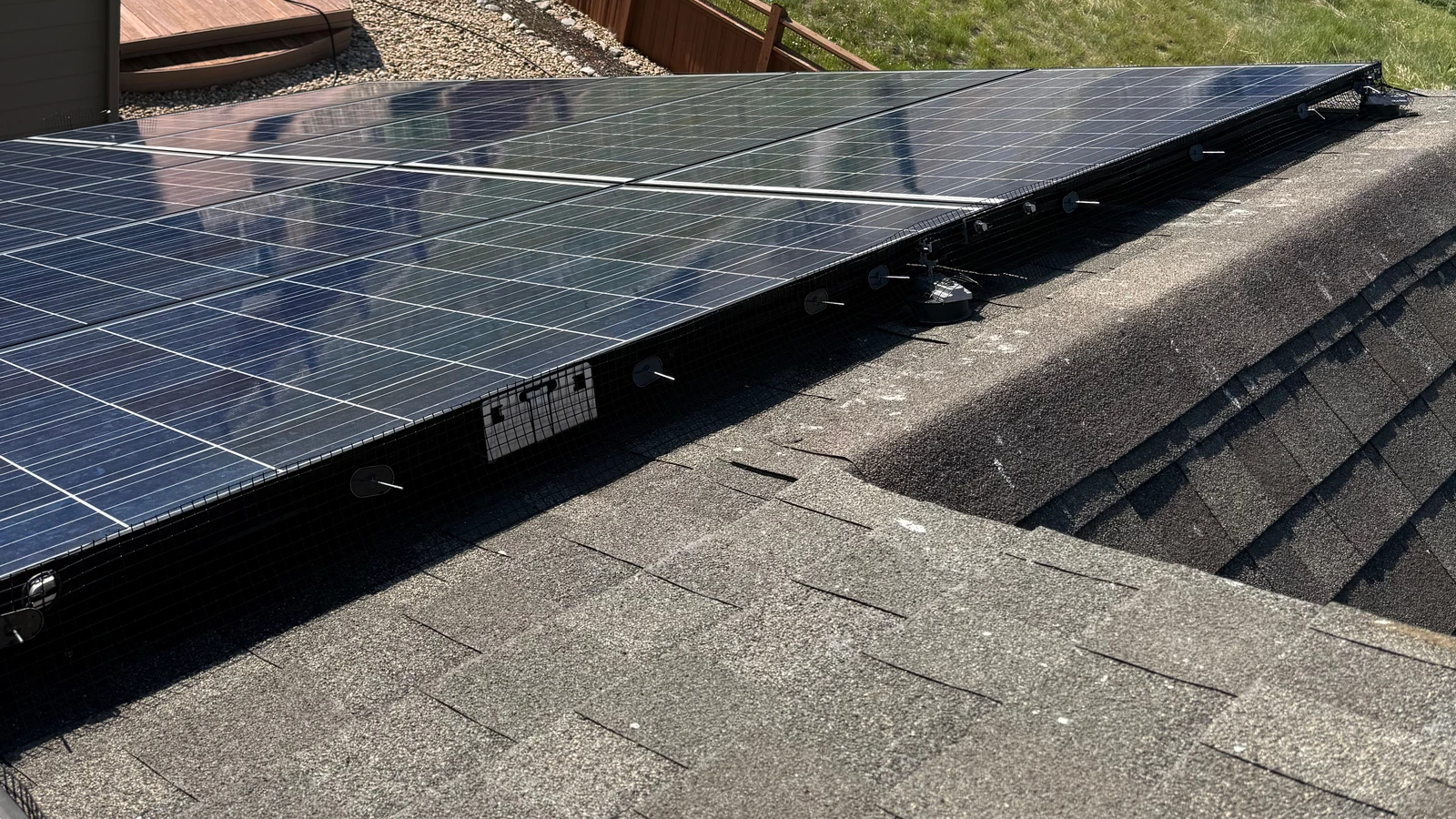
A solar-array critter guard is a purpose-designed perimeter barrier, typically using corrosion-resistant materials, fitted around the edges of the array to close the space between the panels and the roof. It's secured with clips that grip the panel frames — no drilling into panels, no screws through the roof. The mesh and fixings are kept clear of the active panel surface.
What to check when comparing options:
- Is the barrier made for solar arrays, or adapted from another use?
- How is it attached — and does attachment penetrate panels or roofing?
- Is the material corrosion-resistant and UV-stable?
- Does it run the full perimeter, including corners and irregular edges?
- What does the installer do if there's an active nest?
Installation approach
Every job we do starts with a visual inspection of accessible areas — what's under the array, the condition of visible wiring and roofing, and whether animals are actively nesting. We first check accessible areas for activity and visible damage. Any active nest is assessed before closing: federal protections can apply to active nests of certain species, so timing and method matter, and we won't promise instant removal.
Materials are measured and fitted to your specific array — every system is a slightly different shape. We'll confirm timing once we've seen your roof and array layout. Your written quote will identify whether panel cleaning is included and what cleanup is covered, and you'll get photos of the finished work.
Cost and scope
Timing and active nests
Scheduling depends on weather, safe roof access, and whether animals are actively nesting beneath the array. There's an advantage to booking before spring nesting season, but if you're already seeing signs, don't wait for a convenient season — book the inspection and we'll assess what's there.
One thing I'll say plainly: never seal animals inside. If there's an active nest with young under there, it has to be assessed and handled properly first. Any company willing to mesh over a live nest is a company you shouldn't hire.
Warranty questions
A non-penetrating attachment method does not by itself guarantee your warranties are unaffected. Panel manufacturers and installers each have their own terms, and some installer workmanship warranties have specific language about aftermarket additions. Read your paperwork — and note that a guard manufacturer's marketing statement is not a substitute for your actual warranty terms. If you want a second pair of eyes on yours before scheduling, send it over and I'll look at it with you.
Aftercare and summary
Keep your completion photos with your system records. Ask your installer how the barrier should be checked over time — mesh can shift with thermal cycling and storms, and a quick visual check from the ground once or twice a year is cheap insurance.
Seeing birds enter beneath your panels? Contact Mile High Solar Care for a critter-guard quote. We'll inspect, show you exactly what we find, and give you a straight answer.